Seton Hill Hosts Future Masters of Medicine
On October 21, Seton Hill University hosted a session of Future Masters of Medicine, an event series for high school students to discover more about professions in the medical field.
The program was created and is led by Dr. Gregory Bisignani, a local orthopedic surgeon with WVU Medicine. The event series is in its third year of operation and consists of about six events per year. It is offered to Westmoreland county high school juniors and seniors who are invited by their teachers or guidance counselors. This year, Seton Hill University partnered with Saint Vincent College to host the series.
Each session features medical professionals from a variety of disciplines. Each presenter gives students a brief lesson on their area of expertise and a hands-on learning experience to put it into practice.
The session hosted by Seton Hill featured Dr. Heather Walker, an Emergency Medical Physician with WVU Medicine. She gave students an overview lesson on emergency medicine that included what constitutes an emergency, how to properly respond, and the realities of working in a high-pressure environment.
Following Dr. Walker’s lesson, she instructed students on proper suturing techniques. Participating students were then able to try it for themselves, using artificial skin and an authentic suturing kit.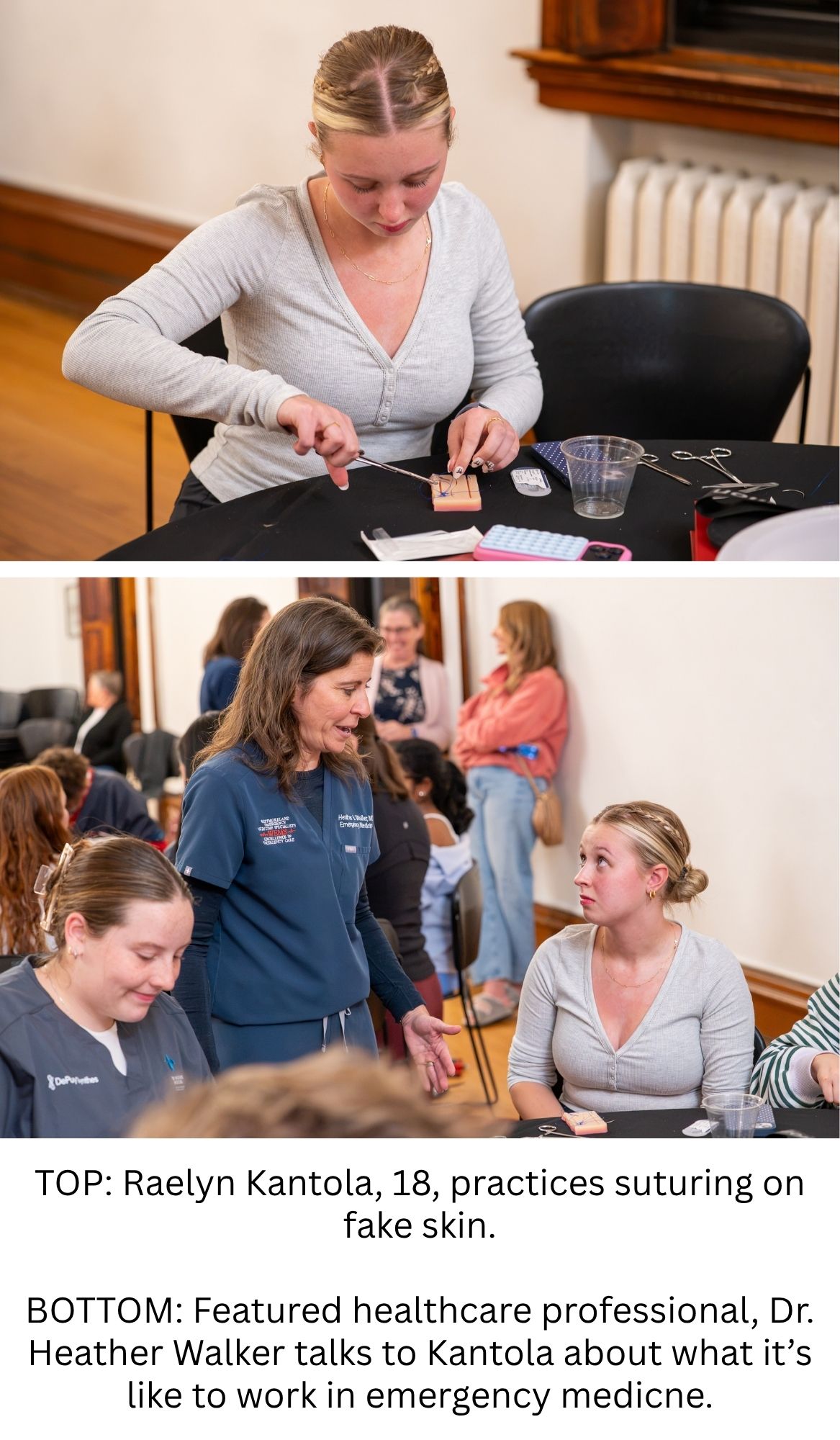
Raelyn Kantola is a senior from Greater Latrobe High School who has attended about eight Future Masters of Medicine sessions. Even as a second-year attendee of the series, she learns and does new things each time.
“I decided to come back because there’s a lot of people that you can connect with and a lot of stuff that you get to learn about,” she said. “I enjoy how many people actually want to come and teach other kids about it [healthcare].”
Kantola attended Dr. Bisignani’s knee arthritis procedure session last year and it left a big impact on her. “I think that’s what I decided I want to do. Like, I really wanted to look into orthopedic surgery, and talking with those people really opened up my eyes,” she shared.
“The quality of healthcare delivery starts with the quality of the education of our healthcare providers, so the future of healthcare is reliant on strong educational opportunities for students. The CHPNS at Seton Hill University is committed to providing this.”
In tandem with the seminar, parents were invited to a panel discussion with Seton Hill faculty who advise and teach students in healthcare-related programs. Parents heard directly from faculty about healthcare education, student experiences, and career pathways. The panel was hosted by Associate Dean of Nursing and Health Sciences Anthony Good.
Seton Hill University is consistently investing in the future of healthcare education. As Seton Hill’s largest school of study, the College of Health Professions and Natural Sciences houses 30 academic programs and the highest percentage of current students. Dr. Demetra Czegan, Dean of the College of Health Professions and Natural Sciences, is excited about the future of healthcare education at Seton Hill.
“The future demand for healthcare professionals is increasing, so it is important we have the educational infrastructure to support our society's needs,” she said. “The quality of healthcare delivery starts with the quality of the education of our healthcare providers, so the future of healthcare is reliant on strong educational opportunities for students. The CHPNS at Seton Hill University is committed to providing this.”
Seton Hill’s commitment to advancing healthcare education is in alignment with Dr. Bisignani’s mission for Future Masters of Medicine. It is his goal to not only expose students to healthcare professions, but also give them new, exciting experiences and hands-on learning opportunities.
The first Future Masters of Medicine session this year featured Dr. Bisignani. He gave a lesson on ACL reconstructions, then performed a live reconstruction on a cadaver donation. He also shared that past sessions have included a vascular surgeon who talks about aortic aneurysms and a da Vinci surgery robot that students practice using.
“The World Health Organization came out a few years ago and said there is going to be a 30 million [person] shortage of healthcare workers worldwide by 2030, so that really struck a nerve with me,” Dr. Bisignani shared. “So what I really wanted to do was motivate kids to go into healthcare, not just physicians, but nurses, physician assistants, physical therapists, etc.”