Seton Hill Lab Experience Earns Students Competitive Internships
One thing that sets Seton Hill students apart from their peers, particularly when it comes to research and lab work, is the amount of hands-on lab time they are able to get earlier in their academic careers.
In Cell Biology, Professor of Biology Jamie Fornsaglio teaches students how to work in sterile environments and take care of living cells in culture, skills that are directly applicable to working in a research laboratory and helps the undergraduates gain knowledge that they can take with them into their future studies and careers.
“In order for scientists who hope to pursue an advanced degree to understand their field of study completely, it's important to see the full picture of what's going on at the cellular level,” Fornsaglio said. “Once students take advanced lab classes, they can choose to work with professors on their own independent research projects.”
That’s just what biology major Briana Kochumuttom did, and it helped her secure an internship at the Children's Hospital of Philadelphia last summer to work on cancer research.
While the forensic science program at Seton Hill has major specific courses, the requirements also include foundational science courses like chemistry and biology. Even if students don’t choose to pursue employment at a crime lab after graduation, their skills are directly applicable to working in any standard lab.
“Our forensic science students are scientists first,” said Assistant Professor of Forensic Science Barbara Flowers. “The skills we teach them make them marketable in a variety of areas.”
The forensic science program is designed to give students a realistic overview of the field and to provide them with experiences and skills that prepare them for internships and to work in a crime lab, such as the Pennsylvania State Police Forensic DNA Division and their Greensburg Regional Laboratory, both located in Greensburg just down the road from campus.
“Students see how forensic science is portrayed in shows and movies, but it is important for them to gain a perspective on what the career is actually like,” said Flowers, who worked in a crime lab for many years. “Our coursework is directly applicable to the real life experiences of those who work in a crime lab.”
Most of the forensic science labs are set up as simulated cases to replicate the tasks in a crime lab: they learn how to properly document and collect evidence, how to institute and maintain a chain of custody, how to perform analysis on the simulated evidence, and how to write a crime lab report – which is quite different from a formal lab report. The students have the opportunity to use instrumentation and perform testing that is currently used by professionals in the field, and are taught how to properly document each step of the analysis so that it will stand up in a court of law. Lastly, they testify as an expert witness on one of their cases in a mock trial.
These lab experiences set a strong foundation for forensic science major Maddie Stout during her internship at the Center for Forensic Science Research & Education this past summer.
“Feedback from both internship site supervisors and from our students supports that they are extremely prepared for their internships and for their careers,” Flowers said. “Much of what our students are asked to do they have already learned as a result of their coursework in our program.”
Both Briana and Maddie discovered something that many other Seton Hill students have found during their internships: their hands-on lab experience sets them apart from undergraduate students at other institutions who may be learning these techniques for the first time during their internships or who haven’t heard of certain equipment or processes that Seton Hill students are already familiar from their coursework in their majors.
Biology Major Researches Cancer-Related Proteins at Children's Hospital of Philadelphia
When Briana Kochumuttom came to Seton Hill, she came with the goal of becoming a physician.
She spent last summer as a volunteer lab assistant at the Main Line Health Lankenau Institute of Medical Research, which was primarily an observational role. This summer she secured a prestigious summer internship at the Children's Hospital of Philadelphia or CHOP.
The CHOP Research Institute Summer Scholars Program (CRISSP) is a competitive 10-week summer program which focuses on providing a mentored research experience for undergraduate students. Only 30 students were selected for the 2026 program, which includes professional development, job shadowing and networking opportunities, in addition to a stipend and housing.
“My science labs and my independent research experiences taught me the foundational skills that I utilized in my internship, from using a micropipette to reading through scientific literature,” Briana said. “In particular, my cell biology lab taught me the skills of cell culture, which I used every day in the CRISSP program.”
While at Seton Hill, Briana was able to grow cells in the lab during her cell biology course, develop an interest in cellular stress and complete a semester-long research project, "The Effect of Taurine on Hsp70 Expression and Cell Viability of Caffeine-Stressed Intestinal Cells," with her lab partners. She also took on an independent research project working with Dr. Fornsaglio and Associate Professor of Biology Nicole McAllister-Conrad that furthered her lab skills and gave her valuable hands-on experience with troubleshooting and sterile techniques.
Briana began working with Dr. McAllister-Conrad during her freshman year of college with an interest in doing research with bacteriophages, viruses that specifically infect and kill bacteria also known as phages. Her current research with Dr. Fornsaglio and Dr. McAllister-Conrad investigates how mammalian cells are affected by bacteriophage exposure.
“These experiences with cell culture helped Briana be prepared for the highly competitive internship she completed this past summer,” Dr. Fornsaglio said. “During her internship, Briana was able to do more, learn more, and contribute more because she had a strong foundation and had learned how to care for cells, which was the basis for her internship work.”
“Briana not only mastered basic (and important) lab techniques like sterile technique, she also designed her own experiments, optimized protocols, analyzed large batches of data, and has presented her work several times both in and outside of the University setting,” said Dr. McAllister-Conrad. “Working with both Dr. Fornsaglio and me, Briana had the opportunity to merge the fields of cell biology and microbiology, experiencing what interdisciplinary collaboration is all about. She has dedicated so much time to this research and her dedication and passion for the work she does is truly wonderful to see.”
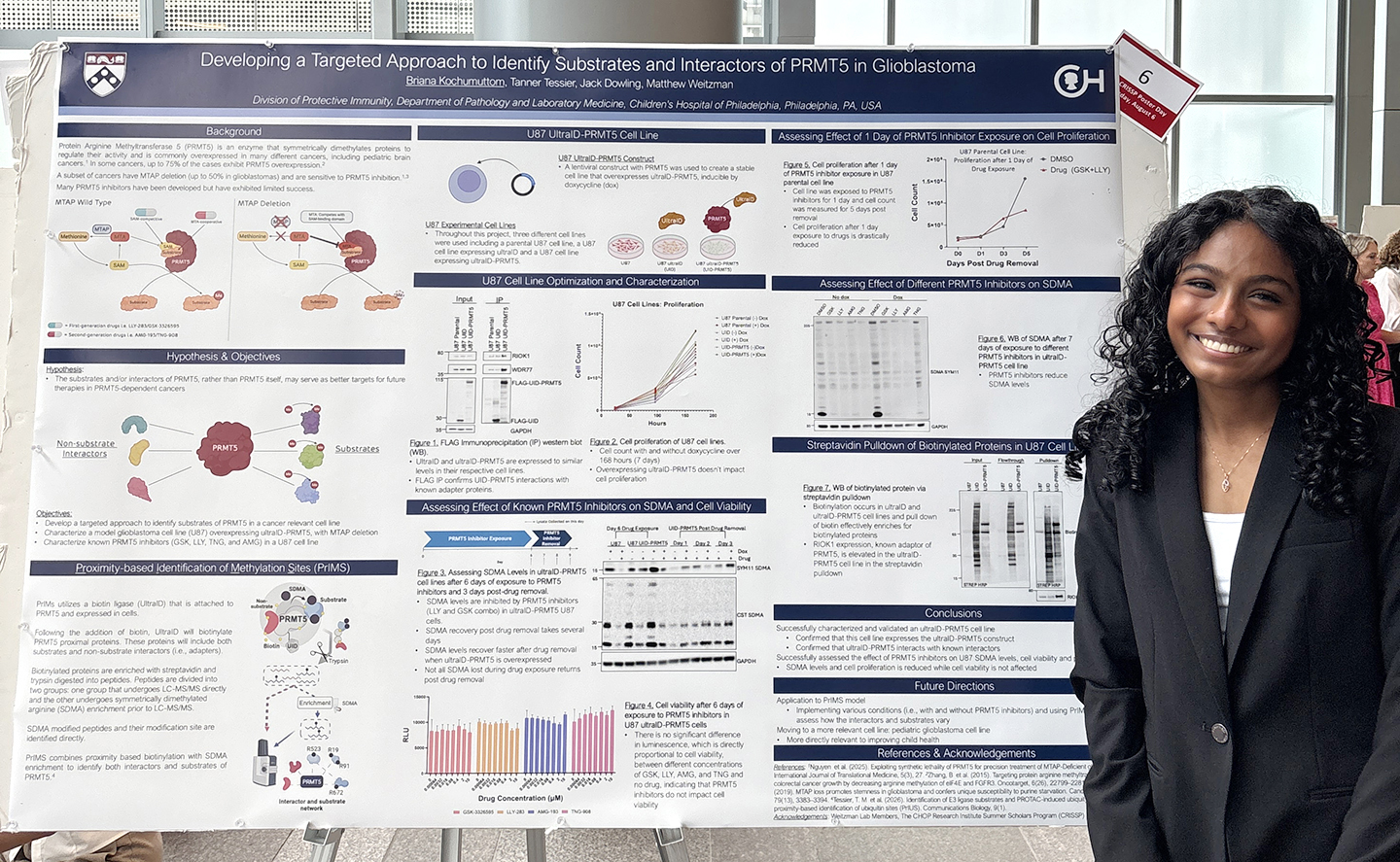 Briana was a part of the Weitzman Lab at CHOP where she joined a project focused on protein arginine methyl transferase 5 (PRMT5), a protein that is commonly associated with various types of cancers.
“A lot of therapies that target PRMT5 have been developed, however none of them have been entirely successful. We hypothesize that the substrates of PRMT5 or the proteins that PRMT5 modifies may serve as better targets for future therapies than PRMT5 itself,” she explained. “The focus of the project is to isolate and identify the substrates of PRMT5 so that they may serve as targets for future therapies of PRMT5 dependent cancers. My role specifically was to work on an approach to isolate the substrates of PRMT5.”
With the guidance of her mentor, Briana conducted experiments as preliminary experimentation and optimization for the bigger project, including characterizing and validating an ultraID-PRMT5 cell line as well as assessing the effect of known PRMT5 inhibitors on symmetrical dimethylated arginine levels, cell viability, and cell proliferation.
Using the lab skills she had acquired at Seton Hill as a base, she was able to add new lab and research skills to her repertoire, in addition to learning more about career options in the medical field and hearing firsthand from a variety of professionals about their work.
“This experience has confirmed my passion for the field of medicine and has made me more certain that I want to be a physician. Outside of the research, I have had the opportunity to shadow doctors in the CHOP system including an oncologist, a geneticist and a urologist,” Briana said. “I've also had access to the CHOP professional network where I have been able to meet with various professionals in the medical field and conduct informational interviews to learn more about their career paths and network. I’ve enjoyed this internship and have learned so much!”
Forensic Science Major Works Cases During Internship at Center for Forensic Science Research & Education
Senior Maddie Stout felt confident entering the lab for her internship at the Center for Forensic Science Research & Education.
The forensic science major plans to graduate in December, and spent the summer building upon the foundation she had built during her Seton Hill education.
“My education at Seton Hill provided me with lots of lab experience before beginning this internship, so I felt very confident entering the lab and working independently,” Maddie said. “I had a strong background in most of the techniques and procedures, as I had previously performed them. In addition to being in the lab, I had also completed a mock trial at SHU, which helped me prepare for the mock trial I completed at my internship.”
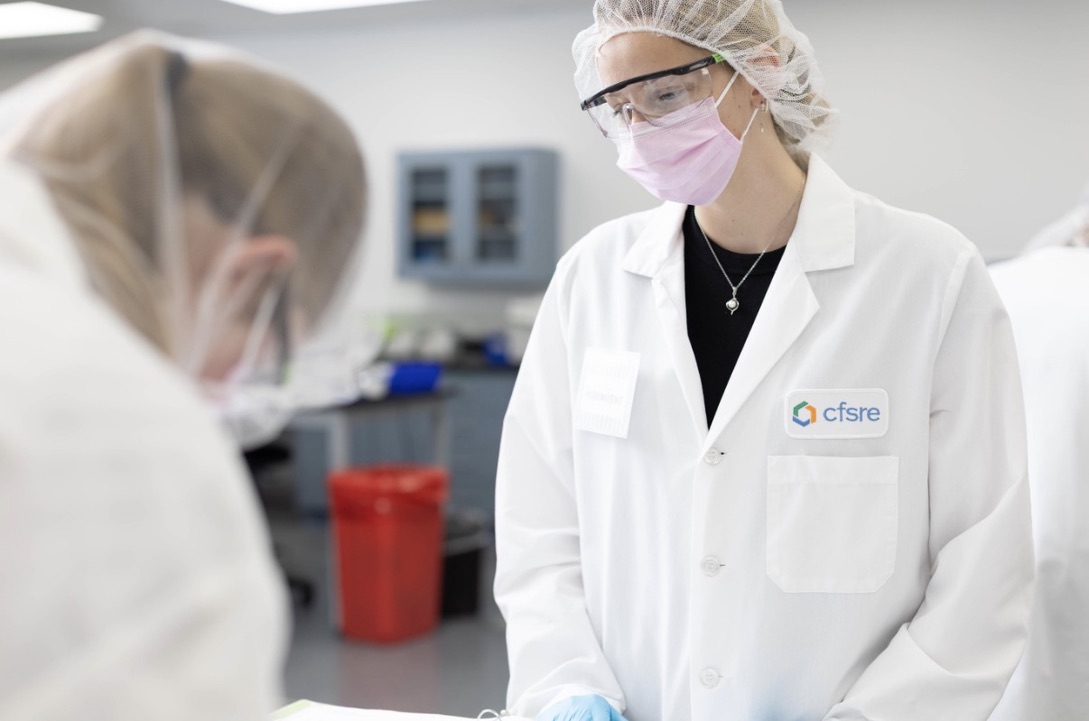 During her internship, she worked on three mock cases, specializing in DNA analysis and forensic serology, which involves analyzing body fluids and determining which body fluid they are. Once the serology process is complete, the samples may be moved into the DNA process, with the end goal of determining if the DNA profile obtained is a match to a reference. Throughout this process, Maddie was also expected to document the evidence and the procedures she used, along with photographing and maintaining a proper chain of custody form.
“The third case I worked on was completely independent from start to finish, concluding with a mock trial to prepare me for my career,” Maddie said. “I gained further experience working with evidence documentation, opening, and proper chain of custody documentation along with sterile lab techniques and procedures.”
Maddie was able to further explore one aspect of her future profession, collaborate with other forensic science students, and tour other forensic science labs including the labs on Dover Air Force Base. She also gained valuable connections in her field as well as insights on how to pursue her career plans: entering the forensic science field after graduation, specifically in DNA analysis or trace evidence.